NUMBER. MUST. GO. UP.
Capitalism is an Alien Intelligence


THE ALIEN INTRODUCES ITSELF
Let me start with two truths about my relationship to economics:
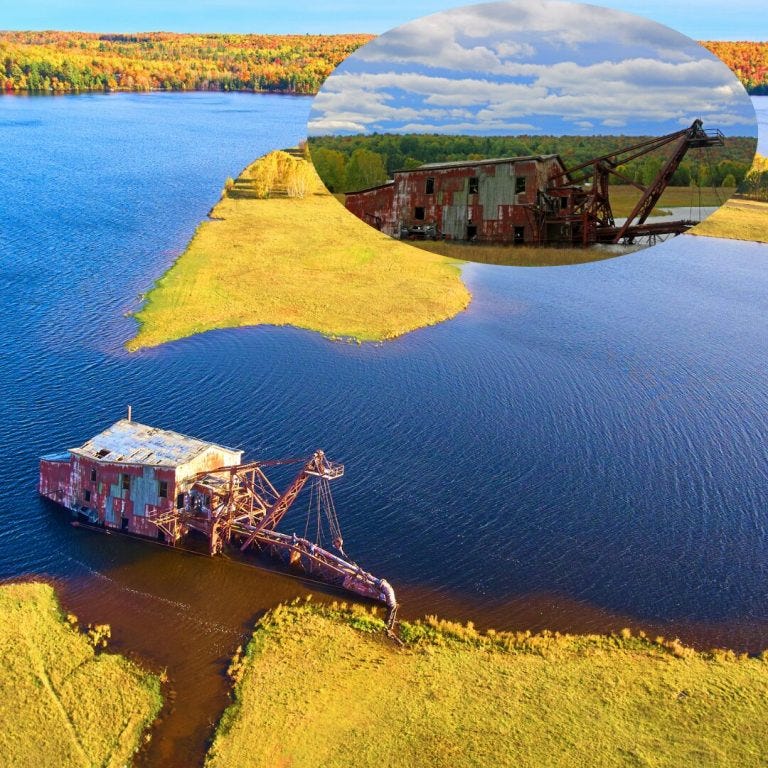
First: I grew up in the Keweenaw Peninsula - often known as the Copper Country - of the Upper Peninsula of Michigan. Born in 1981, I came of age during the ‘booming’ economy at the beginning of the end of history. But while all the macro metrics were going up according to the nightly news, my immediate environment was filled with the rotted-out infrastructure of a post-industrial rust belt, extreme poverty, and no sign of a turnaround. All the copper mines had long-since closed and we lived (literally) in the ruins.

My family was ‘well off’ — as evidenced by the fact that we lived in a 1200 square foot ranch home and not a single-wide trailer — but the dissonance of what I was hearing and what I was seeing (plus my youthful obsession with punk rock) meant that I loosely and furiously knew there was something wrong with capitalism. I had instincts without language: something is extracting value from this place and its people (the news keeps telling me things are getting better - cue Howard Jones), something is poisoning the people and the environment (I grew up swimming in a Superfund site), and I am against it. That was about as far as I’d gotten. This dissonance between the macro and the micro is everything. And, without being overly reductive, it’s my hunch that 9 times out of 10 when you feel like ‘global’ narratives are bullshit, it’s because they aren’t designed to accurately describe any one person’s lived experience. To wit, when you can’t afford gas and groceries but big number go up, you should always be asking — who is GDP for? Who is the S&P for? Who is the DJI for?
Second: I read Neal Stephenson’s Baroque Cycle as it was getting published. If you’re a nerd of encyclopedic proportions, you owe it to yourself to give it a read. Three enormous novels set at the moment when modern finance and modern mathematics were being invented simultaneously in the late seventeenth and early eighteenth century. Newton has his original eureka which led to the calculus (or his ‘fluxions’) — the mathematical language for measuring change — while sitting above the River Cam watching the reeds bend in the current. Stephenson keeps cutting between this and the proliferation of financial instruments: bills of exchange, early derivatives, the birth of the stock market. The punchline is that currency is literally a current. The math and the money are the same operation. Both are about capturing and directing flow. What makes money money isn’t gold or state authority or any fixed thing — it’s movement. Stop the flow and it ceases to be currency at all.
I didn’t have the vocabulary yet to know what I’d understood. But something went off. The question wasn’t just about who owns the factory, or the copper mines, and who decided to move them to Chile. The question also needed to include how the flow runs, who gets to siphon from the stream, who gets to build dams, who gets to be downriver, and who has to watch it simply flow away.
Over the next twenty years I kept unpacking and unpicking my relationship to economics — particularly to the concept, system, ideological formation that is capitalism. What follows (in short and with a very specific focus in mind) is where I’ve landed so far.

A WORKING VS NOT-WORKING DEFINITION
Before the theory, a definitional problem — because in American political discourse, the word “capitalism” has been so thoroughly mangled that using it without clarification would qualify as bad faith if I thought the mangling were done intentionally. In fact, that’s the problem. I think very few people have any real sense of what it is that their trying to describe when they use the term.
Here is the most colloquial, everyday, ‘common sense’ version that I see most people parroting: capitalism is a policy preference. Free markets versus government intervention, individual enterprise versus collective ownership. You can be “for capitalism” or “against capitalism” the way you’re for or against a particular tax rate. Bernie is against it. Paul Ryan is for it. Pick a side.
I’m not sure it makes sense to call this description wrong as it’s so far downstream from anything that could count as a definition. While it is, as I see it, a debate about the relative merits of selfishness, justice, fairness, and the larger question of what we owe to each other. Capitalism as such largely remains untouched in that conversation.
Capitalism is a mode of production — a set of structural relationships through which labor, goods, and value get organized and circulated. And at this point in history, it is total. Sorry dudes. The sociologist Immanuel Wallerstein spent his career making this argument: once the capitalist world-system achieves global integration, there is no outside. Every nation-state, regardless of its ideological posture, is integrated into capitalist circulation as either core, semi-periphery, or periphery. The system doesn’t care what you call yourself. You’re in the current now.
Take China, for example. Anyone with a few brain cells to rub together knows that China (CCP and all) is deeply imbricated in global capital — hopefully that isn’t news. But Quinn Slobodian’s Crack-Up Capitalism showed me the depth of the entanglement in a way I hadn’t quite grasped. China’s economic boom of the last few decades was driven in significant part by Special Economic Zones — hundreds of them, especially along the Pacific seaboard — where the normal strictures of the CCP don’t apply, and capital gets to operate with a freedom that would make Milton Friedman blush. These zones generate enormous wealth, which flows upward to the state that officially opposes capitalism. The ideology says one thing. The plumbing says another. The zones are not a contradiction of the Chinese communist project. They are how it funds itself.
Take the Nordic countries for more examples. I long to live in the glorious welfare states of Finland — finally get some respect for all this SISU — or Denmark or Norway. But these countries are profoundly capitalistic. They just choose to allocate their resources in such a way as to, ironically, ensure the longevity of capitalism in a way that short-termist American Randian ‘get rich or go fuck yourself’ thinking does not. Never forget that the reasons the Gilded Age oligarchs did so much public philanthropy (in their own words if you care to go look, Carnegie was particularly vocal about this) was because they knew the pitchforks would be coming otherwise.
I say all of this as someone who describes himself as a socialist or a communist or a Maoist third wordlist or a democratic confederalist (depending on who I’m trying to bother on any given day). But as a proud resident of Pasadena, CA (Jack Parsons Lives) I am also, by necessity, an active participant in global capital. I’m one of the bosses at the advertising factory for fuck’s sake. Not to mention that I have a bank account, a 401K, plenty of debt, pay rent, sell my labor, and participate daily in a system I did not choose and cannot individually exit. You can oppose the logic of a system you are structurally required to operate within. What you cannot do is pretend you are outside it.
The system is the ocean. We are the fish. It’s hard to see the ocean when you’re swimming inside of it. Nevertheless, as one who feels shame for their still being air to breathe in hell, I perpetually have tried to crawl out of the ocean and survey it from above to get a better handle
A MORE FORMAL EDUCATION
Marx is where I started, and for good reason. His diagnosis of capitalism is devastating because he helps you realize that what you experience as a human swimming in capitalism and the why and how behind that what are at great odds. There’s a reason why Ricouer identitied him as the first of the three great ‘masters of suspicion’, with Nietzsche and Freud being the other two. Workers produce more value than they receive in wages; the difference gets pocketed as profit; this is not incidental to the system but its operating principle. Nevertheless this very simple logic is buried under layers of super structural (read: cultural) sedimentation, largely because of the fact that we interface with the world through money — currency. The immediacy of our lives is already in a state of abstraction from the site of value generation, i.e., labor. Once you understand where and how to look, the contradictions of capitalism are visible, the mechanism is exposable, and the implicit promise is that once enough people see it clearly enough, you can and will collectively do something about it (because Marx was a good Kantian and this is really all about ‘the kingdom of ends’ formulation of the categorical imperative — but that’s a different essay).
Adorno is where that promise of the easy clarity I thought I could provide to people started to curdle. Writing in the mid-twentieth century, he and Horkheimer watched the contradictions Marx identified get smoothed over by stage management (in large part, by the advertising factory, which is why I often “joke” that I’m actually just Wadorno). The culture industry produces just enough fantasy structure and consumer satisfaction to keep people from noticing (or caring) they are not satisfied. Bernays learned from his cousin Sigmund Freud about the power of identification as an ego-defense mechanism and the WD-40 was applied to the gears. The atomization born from the zero-sum game of wage chasing, which led to the progressive erosion of the social bonds through which collective resistance is even imaginable, does the rest. The gaps in the system don’t get fixed; they get administered. Perhaps his most unsettling yet palpable claim was that critique itself gets absorbed — that the system has learned to digest its own opposition and sell it back as content. They were selling Che Guevara t-shirts at Hot Topic when I first read Dialectic of Enlightenment, after all.
Deleuze and Guattari, writing in the 1970s, pushed this somewhere much stranger, much more alien, occasionally much more annoying (if we are keeping it 100p), but also much more elucidating if you can shake off some of your deepest assumptions about actions, actors, agents, etc. Capital, in their framework, isn’t just a set of class relationships, or an economic system with power brokers and pawns, or a cultural mechanism. It’s a logic — a decoded flow that breaks down existing social forms and reconstitutes them in its own image, not because anyone decided this but because this is what the logic of capital does once it gets up and running. Their key term here is reterritorialization. Capital is constantly deterritorializing — breaking down fixed structures, liberating flows — but those flows needs somewhere to land. They reterritorializes on existing human social forms, colonizing them to give its operations a human face. The family. The nation-state. Corporate culture. The startup. These aren’t in opposition to capital; they’re the forms Capitalism inhabits and expresses itself through (these are Spinoza’s modes, where Capitalism is Substance — deus sive natura sive global finance). Much like what Marx was pointing to with the base vs. superstructure distinction, or what Horkheimer and Adorno were helping to identify via their work on the culture industry, this all makes pure extraction feel like something else.
The American worker who hates unions but loves his company isn’t deluded exactly — he’s been successfully reterritorialized. His loyalty to the company, or the image of himself as ‘hard working American’ is real. The firm has given him a simulacrum of an identity, a community, a sense of purpose. That these things are also the mechanisms of his extraction doesn’t make them feel less real. This is what makes capital so much harder to oppose than Marx had hoped. Capitalism doesn’t just take things from people. It gives them interpretive frameworks through which to make sense of their lives and to explain away their misery and degradation. It makes those frameworks feel like the only home you know.
By this point in the tradition, the image of the fat-cat capitalist with the monocle and and the cigar as the agent of the capitalist machine has basically evacuated the picture. Capital isn’t something powerful people wield. It’s something powerful people are also subject to. The capitalist class has become something more like a weather vane — useful for indicating direction, not responsible for the wind. Anyone who has spent time among the ‘leadership class’ of contemporary American capitalism (I have — I’ve had meals with multiple billionaires and entire C suites of Fortune 50 companies) will know this to be true for one simple reason: the smooth running, all-consuming order of global capitalism is arguably the most astonishing invention in human history. But the people who are allegedly at the wheel? Let’s just that say, as a rule, they are not an impressive bunch. Corporate inertia is the true driving force, most folks at the helm essentially are just pushing the door open and door close button an elevator and clapping like trained seals when the door does what it was going to do anyways.
And then there is Nick Land, who in the late 1980s and early 1990s took this framework and ran it somewhere most people didn’t want to follow. I sure didn’t. Land read capitalism through Georges Bataille, one of the S-Tier intellects and creative geniuses of the 20th century. A profoundly strange and creative thinker who brought entirely new tools to bear on questions of human existence. Land read Capital through Bataille — and accordingly he sees Capital as genuinely alien. He often describes capitalism as an inhuman intelligence bootstrapping itself into existence through human history, using us as its hardware, pointed toward a future that has no particular use for us. Land has since become an apostle for the very machine he was diagnosing, which is its own cautionary note. But you don’t have to follow him into the abyss to recognize he was pointing at something real. Number goes up. The thing it supposedly measures gets worse for the people who, in theory, should be the only ones who care about that number. At some point the number stops measuring anything that normal humans have access to. At some point the number is the thing, and everything else is externality.
HE ADMIT IT!
The problem with all of this, as I said at the outset, is the vocabulary. The further into this tradition you go, the more precisely you can describe the ocean, and the fewer people can hear you. The abstract and alien system requires and abstract and alien description, which those of us in the concrete and familiar will find incomprehensible.
This is where Brian Armstrong, CEO of Coinbase, comes in.
In May 2026, Armstrong sent a memo to Coinbase employees announcing he was cutting 14% of the workforce. It is the most lucid statement of capital’s current self-understanding I have ever encountered — not because Armstrong is a theorist, but because he isn’t. He was just speaking on behalf of the logic in real time to the people it was consuming as fuel.
Now, to the key passage that prompted this essay:
“We are not just reducing headcount and cutting costs, we’re fundamentally changing how we operate: rebuilding Coinbase as an intelligence, with humans around the edge aligning it.”
“Rebuilding Coinbase as an intelligence.” Not: AI will help our teams do more with less. The company is the intelligence. The humans are not the company. They are peripheral. They are aligning it — which, if you have followed the discourse around AI safety, is the technical term for the work of keeping an AI system pointed toward human values. Armstrong has just described his remaining employees as the corrective feedback mechanism on a non-human process. We are basically the orcs trying to ensure that the cave goblin stays pointed in the right direction when it’s time to smash down the doors of Minas Tirith.
If you read the whole memo, you’ll notice a blindly conspicuous absence: any mention of customers. Any gesture toward how this restructuring serves the people who use Coinbase. The normal grammar of these announcements — “we are doing this difficult thing so that we can better serve you” — is simply missing. The logic is entirely self-referential: leaner so we can be faster so we can grow. Toward what? The memo doesn’t say, because it doesn’t need to. The growth is the point. The process is self-authorizing. Number. Must. Go. Up.
Marek Poliks and Roberto Alonso Trillo, in their 2025 book Exocapitalism: Economies with Absolutely No Limits, give a useful vocabulary to say precisely what Armstrong is describing.
Their central argument is that capitalism has evolved past its human substrate. It is not a class relationship or a set of institutional arrangements. It is a “germ” — a granular algorithm of arbitrage that can run on anything. Its axiomatic is ‘buy, hold, sell’. Value is generated not by labor, not by utility, but by the volatility during the hold phase — the friction, the time-dilation, the difference between the buy and sell states. Capital is simply the machine for harvesting the gap between buy and sell, and it doesn’t care what it’s running on.
Their term for what Armstrong is executing is lift. Lift is the tendency of capital to move away from fixed costs, material dependencies, and human affairs, i.e., lifting itself out of the mucky and imprecise materiality it was born from.
The airline industry is the clearest demonstration available.
You probably have an intuitive sense that something is structurally weird about airline economics. The extent of the weirdness is worth spelling out. In 2018, American Airlines’ total operating income of $2.66 billion was less than the profit the company made through its co-branded credit card partnerships alone — meaning the actual flying of planes filled with passengers was a net drag on the business. Delta’s loyalty program generates a 10.5% profit margin; strip it out and Delta runs at a loss. Southwest earned nearly $900 million from its loyalty program in a single quarter of 2024, the overwhelming majority from credit card spending rather than anything involving an aircraft.
The mechanism: banks like Chase or American Express pay airlines billions of dollars upfront to license the airline’s brand and buy frequent flyer miles in bulk. The airline books the cash immediately. Some of it goes on the balance sheet as a future obligation — the flights they’ll eventually owe you — but a significant portion books as pure revenue right now. When you swipe your card at a grocery store, the airline makes money. If you never redeem your miles, the airline eventually books that liability as profit too. The flying, meanwhile, involves fuel costs, labor, maintenance, weather delays, and the entire chaotic material reality of moving physical human bodies through the air. It is expensive, unpredictable, and increasingly beside the point.
The abstract instrument — the point, the mile, the financial derivative of air travel — has become more valuable than the underlying reality it was supposed to represent. The airline is not in the business of flying people. It is in the business of manufacturing a financial instrument that banks find useful, and flying people is the residual obligation that keeps the instrument credible.
Armstrong is doing this to his workforce. The material operation of employing humans who do work is drag. Coinbase as Intelligence is the lift. The employees “around the edge aligning it” are the minimum material presence required to keep the abstraction pointed at something recognizable as a company for the time being when us flesh sacks are still out here wondering what the hell the company is.
This is where Poliks and Trillo’s push past Deleuze and Guattari helpsl. D&G argued that capital always needs somewhere to land — it reterritorializes on human social form to give its operations the appearance of meaning and purpose. Poliks and Trillo’s argument is that this need is flagging. The reterritorialization in Armstrong’s memo — the brief, perfunctory passage about being grateful to departing employees — sits in the document like a vestigial organ. The logic has already moved past it. Armstrong didn’t feel the need to perform a customer-benefit clause because the intended audience for this memo was markets. The shareholder gaze doesn’t require the fig leaf that this has anything to do with democratizing markets or improving anyone’s lives. At this point, they would find such an attempt vaguely embarrassing.
The ideology dropped the mask not because anyone felt compelled to be honest. The mask has became unnecessary friction. It’s worth noting that the Trump administration’s absolute lack of an attempt to ‘sell’ the war on Iran is, I’d argue, a result of this same condition. Trying to gin up a Colin Powell, yellow-cake uranium, UN Speech moment? That’s a lot of work. Why bother?
This brings me back to Stephenson, and the reeds in the current above the River Cam. What Stephenson taught me — and what I only half-understood reading him in my early twenties — is that currency and current are the same word for a reason. What makes money money is not what it represents — but that it moves. The moment it stops moving it ceases to be capital and becomes a hoard, a relic, a dead thing. The entire logic of the system is oriented toward keeping the flow running, accelerating it, removing whatever impedes it.
The humans in Armstrong’s memo are impediments. Not because they are bad at their jobs, but because they are material that drags. They have needs, speeds, and limitations that the current doesn’t share. They are the reeds bending in the water, not the water itself. Those reeds might have been how Newton was able to begin conceptualizing a new mathematics that could describe systems in states of change, but those systems themselves don’t require those descriptions. Those descriptions are for our plebeian brains. The system just flows.

I want to resist the pull toward resolution here because it would be false. The tradition I have been sketching doesn’t offer a program, and I am suspicious of people who claim they have one. If capital is a substrate-agnostic germ lifting off human social structures and reconstituting itself at scales beyond human management, the question of what to do about it is harder than it looks.
What I can say is this: the Armstrong memo is useful precisely because it is so unguarded. He wasn’t trying to describe what capital has become. He was running the logic in as close to colloquial language as you can get to an audience that included the people the logic was consuming. Fifty years of critical theory has been trying to reach the moment where the thing describes itself clearly enough that you don’t need the theory anymore. A Silicon Valley billionaire, in a memo about layoffs, announced that his company is now an alien intelligence and his remaining employees are the alignment layer. Aligning it towards what? Growth! For what? Growth! For why? Growth!
The heebie jeebies I hope you feel reading about this are the correct response.
I have got to stop reading you first thing in the morning. I’m going to replace my mouthwash for cyanide one of these days.
Fantastic read